Our Langlees ELC Centre Froeble Journey So far...
Wonderful Wood Work
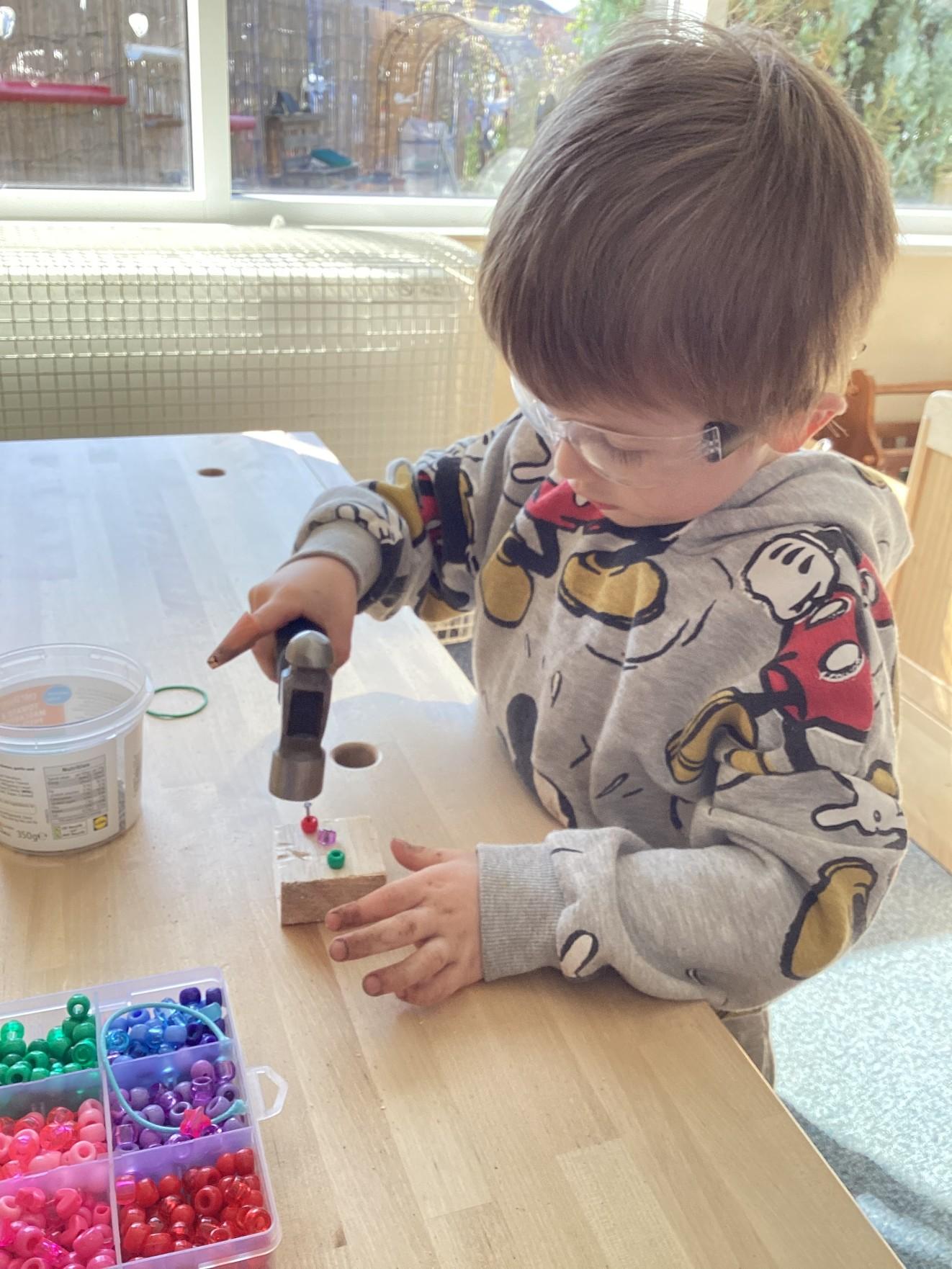
Keira has recently completed the Froebel in Childhood Practice course through Edinburgh University. As part of this course, she has established woodwork becoming a core provision with a new designated woodwork area.
Woodwork has a long history in early childhood education dating right back to the beginnings of early childhood education with Froebel’s Kindergarten in Germany back in the 1800s. Since then it has been embraced by many countries all over the world. Woodwork is one of those really special activities that truly engages children and encompasses all areas of learning and development. Children really respond to the challenge and very much enjoy working with wood and real tools. It encompasses so much learning – children will be developing their physical coordination, fine and gross motor skill and hand eye coordination; they will be learning basic mathematical concepts, such as shape and measure and develop their mathematical thinking and problem solving skills; they will be developing their understanding of the world – seeing tools as basic technology, understanding wood as a material and observing many scientific concepts such as the rotation of a wheel, levering nails back up or using a drill to drill holes; They will be developing their language with new vocabulary, using language to talk about their ideas and to problem solve; and children can develop their mark-making and drawing to express ideas on paper and also mark on the wood itself. But there are two areas where woodwork really excels. Firstly, it develops children’s self-esteem and confidence – it is really empowering for children to create with real tools, and they take great delight in their achievements - it really develops a can-do spirit, and secondly it develops children’s thinking skills –their creative and critical thinking as they problem solve and express their imaginations with wood – which is not easy to work with! In terms of safety, this is prioritised at all times.
We adhere to strict guidelines such as the children must wear safety glasses at all times and sawing is only ever done with 1:1 adult supervision. Of course, we cannot eliminate all risk, and there will be the occasional bruised thumb, but part of children’s development is that they need to learn to manage risk and make judgements to protect themselves, so they are better able to make decisions in all situations that life presents.
Woodwork is also wonderful activity to also do alongside your child at home – tools make great presents! The book ‘Learning Through Woodwork’ by Pete Moorhouse could make good reading to inspire you. We very much look forward to the children showing you what they have created – but remember the real product that is being made is the changes within the child! As children make with wood, they are learning skills that will empower them to shape their world - encouraging them to become the innovators, makers, sculptors, tinkerers, engineers and architects of tomorrow!
Brilliant Block Play
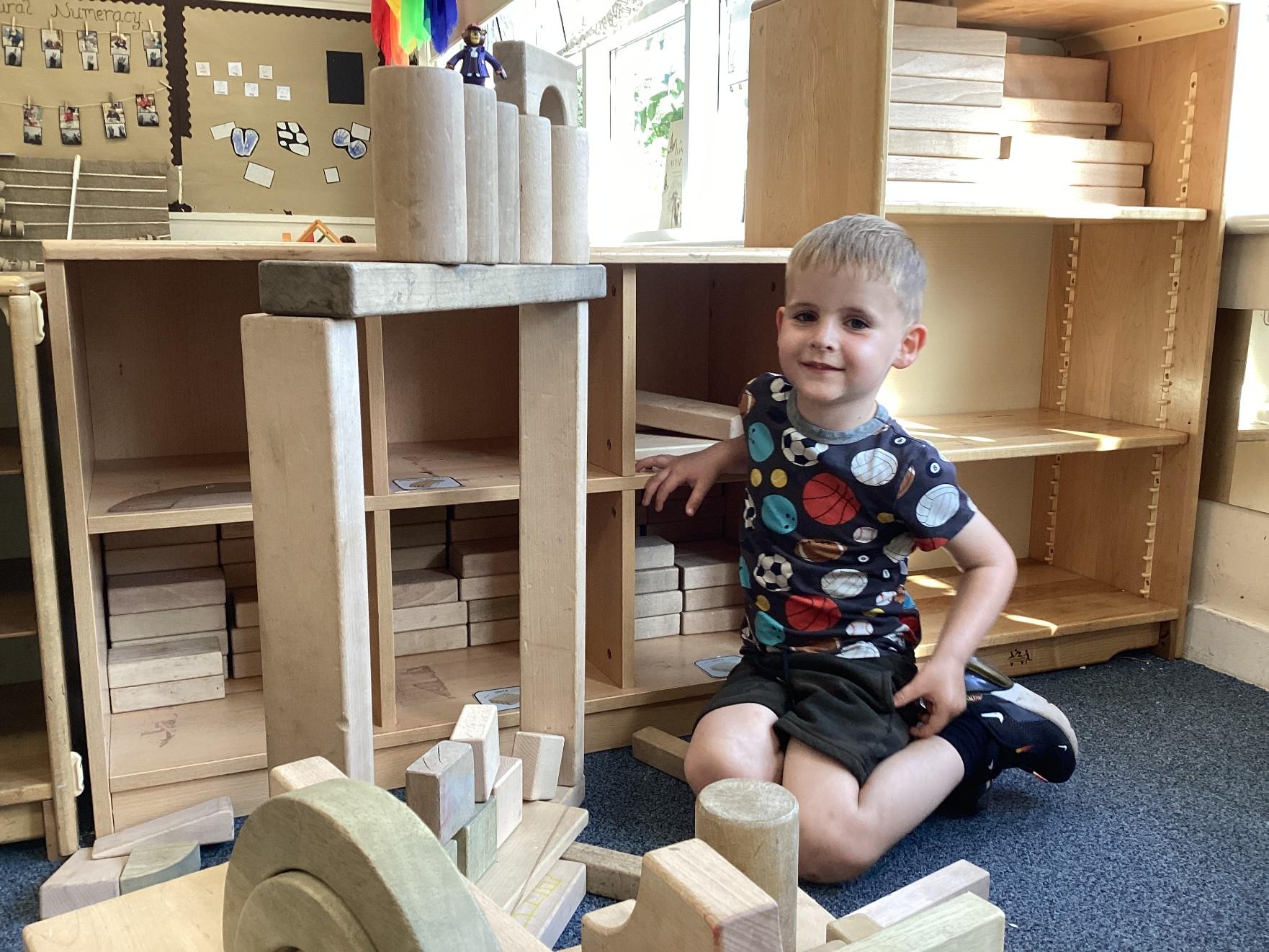
Caitlin has recently completed the Froebel in Childhood Practice course through Edinburgh University. As part of this course, she is undertaking a project to develop block play within our core provision. We believe this is a fantastic learning resource for children to develop a wide range of skills and knowledge, it also supports resilience and problem-solving skills and teamwork. Did you know that there are seven stages to block play? As part of her Froebel Project, Caitlin has been working with the children to develop an understanding of some of the stages:
Stage 1: Exploring and Carrying Blocks.
Stage 2: Stacking Blocks.
Stage 3: Making Bridges.
Stage 4: Making Enclosures.
Stage 5: Making Patterns.
Stage 6: Constructing and Naming.
Stage 7: Planning Constructions.
When children are engaged in block play they illustrate a wide range of curricular experiences as well as the more obvious Mathematics and Technologies. They discuss, hypothesise, share, develop narratives, express ideas. They represent what they see in the world around them in the local environment and further afield. Children do not have to share the same language to play together with blocks. They represent experiences they have had and can use the blocks to rehearse past or future events. Froebel’s Gifts Three to Six are an ancestor of our modern blocks Block play supports children’s holistic development and learning across the curriculum. In play with blocks children can demonstrate what they know, expressing their ideas with creativity and imagination. The adult role in block play enables block play by observing, supporting and extending. The way blocks are stored supports children’s access, learning and choice, children learn to manage risk in block play.

Cooking with families
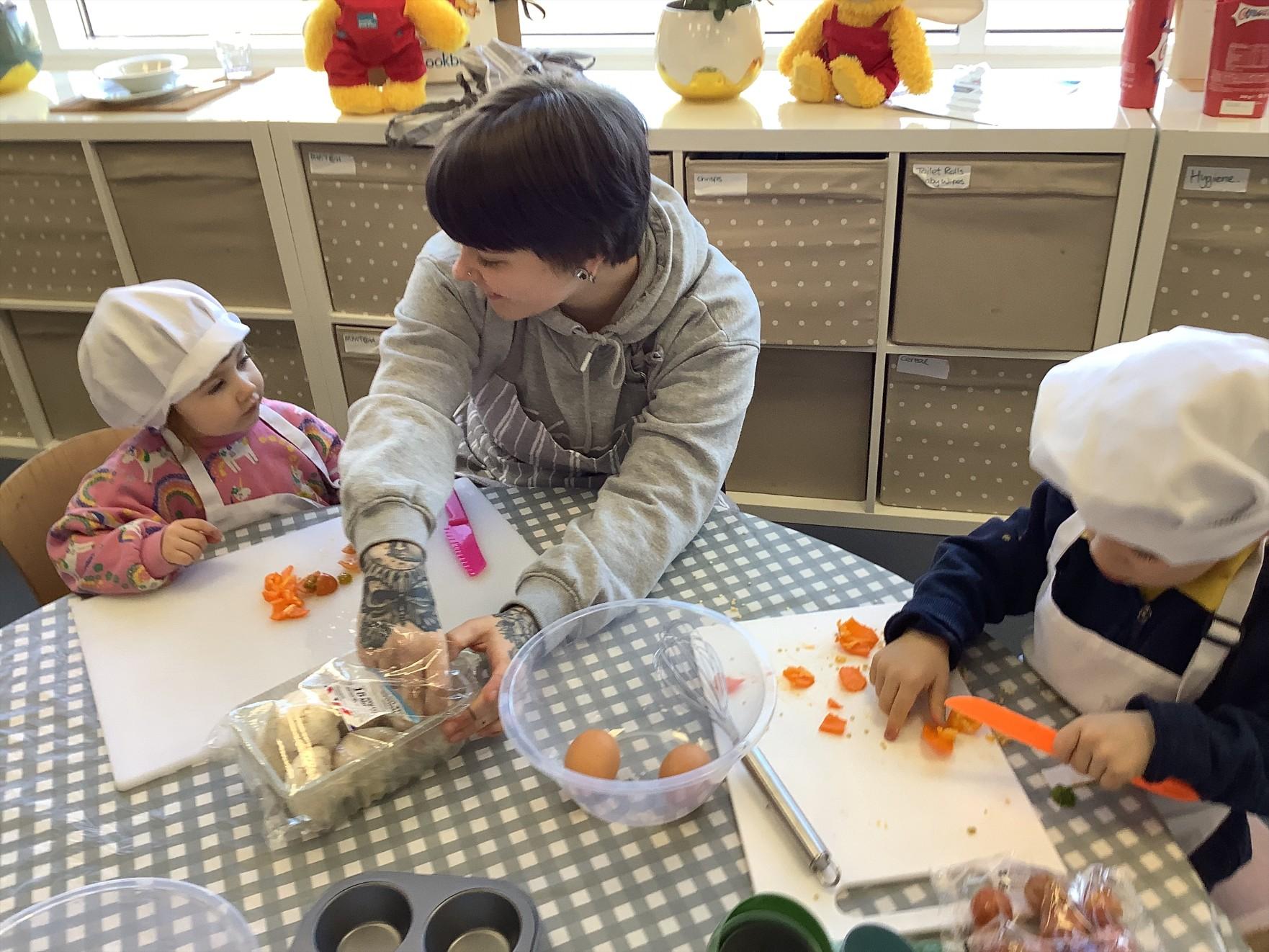
Kirsten has recently completed the Froebel in Childhood Practice course through Edinburgh University. As part of this course, she has developed cooking with children and families within the setting.
We have recently further developed our Marvellous Mealtimes initiative by launching our Marvellous Mealtimes At Home programme, where we invite a small group of children & families into the nursery on a regular basis to take part in cooking experiences with their child/children. This allows families to spend quality time with their little ones whilst learning how to cook nutritious, budget friendly meals, increases confidence, strengthens relationships & further develops cooking skills!
Did you know that Cooking with children is one of Frobel’s occupations? Froebel’s Occupations are educational activities which enable the child to be creative, to communicate, develop physical and problem solving skills, and develop an understanding of the natural world. They are enjoyable for children at the same time as equipping them to understand the world of work and develop skills which bring satisfaction and commitment. In an early years setting today, Froebelian Occupations would be activities such as sewing, clay, woodwork and cooking. Cookery provides an exciting learning opportunity for all children. It allows children and adults to work together with the adult guiding the child but giving the child freedom to make decisions and undertake important tasks such as chopping vegetables. Through finding out where food comes from and how it grows, the child is connected to nature and has a greater understanding of the world around them. Cooking plays an important role in supporting teaching and learning and supports all areas of the curriculum.
Froebel believed that children should feel a sense of connection between home and school and that educators should work in close partnership with parents. Cookery presents many opportunities to connect with the family and the wider community. Festivals and special occasions provide a time to prepare and share food together and learn about different cultures. These occasions provide a chance to introduce children to new tastes and foods they may not have experienced before. Inviting parents, grand-parents and carers to come in and share special recipes and cook with the children is a wonderful way to involve children in cultural traditions.
Inviting families to cook with their children creates a sense of connection between home and school. Children often express great pride in showing their parents how they learn to cook at nursery. Hugely valuable links can be made as families can share favourite recipes or a cultural dish.
‘Many aspects of Froebelian theory can be closely linked with the practice of cooking, giving it an important role to play in supporting learning and teaching’ (McCormick 2012: 153)